%20Loans%20in%20Private%20Credit.png)
What is PIK and How does it Work?
In a conventional loan, interest is paid in cash at regular intervals. With PIK, interest is instead added to the outstanding principal and compounds until repayment at maturity. A PIK loan can be structured from origination, where deferred interest is an embedded feature, the borrower can draw on from day one, or it can include a PIK toggle, an option negotiated at origination allowing the borrower to elect in-kind payment on part of the interest margin, typically up to 50%, at a modest spread premium. The toggle is the more common structure in senior private credit.
“Two Perspectives on the Same Feature”
For borrowers, the appeal is liquidity preservation. A company in growth mode, managing through elevated capex, or navigating margin compression can redirect cash towards operations rather than debt service. Many borrowers negotiate toggle options as a buffer, not expecting to use them, but valuing the optionality.
For lenders, the tradeoff is less comfortable. By deferring cash income, the lender bets that repayment capacity holds through maturity, while the loan balance compounds upward. More importantly, PIK removes a natural early warning signal. In conventional lending, a missed or delayed payment prompts a review. A PIK loan continues to perform on paper even as borrower fundamentals deteriorate.
“A More Competitive Market, and Looser Protections”
The growth of PIK is not solely a function of borrower stress. It also reflects a structural shift in the balance of negotiating power. As more capital entered the space and competition for deal flow intensified, borrowers found themselves in a stronger negotiating position. Covenant packages weakened as a result: where most private credit loans carried at least one financial maintenance test a decade ago, covenant-lite structures have become increasingly common as lenders accommodated borrower preferences to win mandates. PIK toggle provisions followed the same logic, migrating from mezzanine and subordinated debt into senior lending across both Europe and the US.
The Data: A Clear Upward Trend
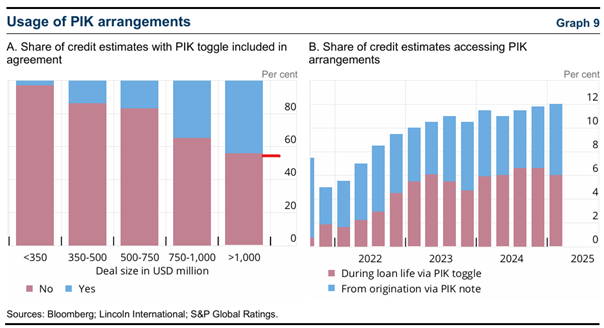
Use of PIK toggles has been accelerating in recent years, and in particular through PIK toggle activation during the loan term. Lincoln International, which tracks PIK across its private credit valuation reviews, recorded PIK usage rising from 7% of loans valued in Q4 2021 to 10.6% by Q3 2025, with 57% of that involving PIK toggles activated during the loan term rather than provisions included at origination.
The FSB's own analysis, drawing on a broader dataset combining Bloomberg, Lincoln, and S&P Global credit estimates, shows total PIK access approaching 12% across the private credit market by early 2025, up from roughly 4-5% in early 2022. According to the FSB's report, nearly half of private credit agreements for deals above $1 billion now include a PIK toggle provision at origination, reflecting how PIK has become a structural feature of large-cap lending. The share of borrowers activating PIK during the loan term has also risen steadily, with mid-loan toggle activation accounting for a growing proportion of total PIK usage.
Notably, the FSB finds that in a study of US BDC loans, the exercise of PIK toggles is associated with a statistically significant increase in the likelihood of a loan becoming delinquent in the following quarter. A partial exception applies to sponsor-backed borrowers, which appear less likely to progress from delinquency to outright default, likely reflecting the sponsor's ability to inject liquidity during periods of stress.
The Monitoring Imperative
In conventional lending, cash interest payments serve as a dual function: they provide income, and they provide information. Each payment is an implicit signal that the borrower retains the capacity and intention to service its obligations. When a payment is missed, the lender has a clear, time-stamped event to respond to.
PIK removes this signal. A loan that is technically performing, with interest accruing to principal and no formal default declared, can mask a borrower whose operating performance has materially deteriorated. The lender's position compounds upward in nominal terms while the underlying credit quality trends in the opposite direction. This dynamic becomes particularly dangerous when financial ratios are already under pressure: declining interest coverage, weakening margins, or rising leverage can all develop quietly in a PIK structure without triggering the review that a missed payment would have prompted.
This is why proactive, structured monitoring of borrower fundamentals has become particularly important in PIK-enabled portfolios. Rather than waiting for a payment event to trigger a review, lenders need to maintain a continuous view of the indicators that payment behavior would otherwise have surfaced: revenue trends, margin evolution, cash conversion, leverage trajectory, covenant headroom, and liquidity runway. Deterioration in these metrics, potentially months before a borrower elects to toggle, is where the early warning signal now lives.
Is PIK something you are navigating in your portfolio? We would be glad to hear how you are approaching it.
Directly reach out or check smartZebra's solution - Credit Spread & Interest Rate for you.