The Beta Factor: a practical guide for business valuation

6
min read
The five decisions behind a defensible beta — peer group, raw-beta settings, quality criteria, gearing and unlevering — in one free, practical guide for auditors, tax advisors and valuation teams.
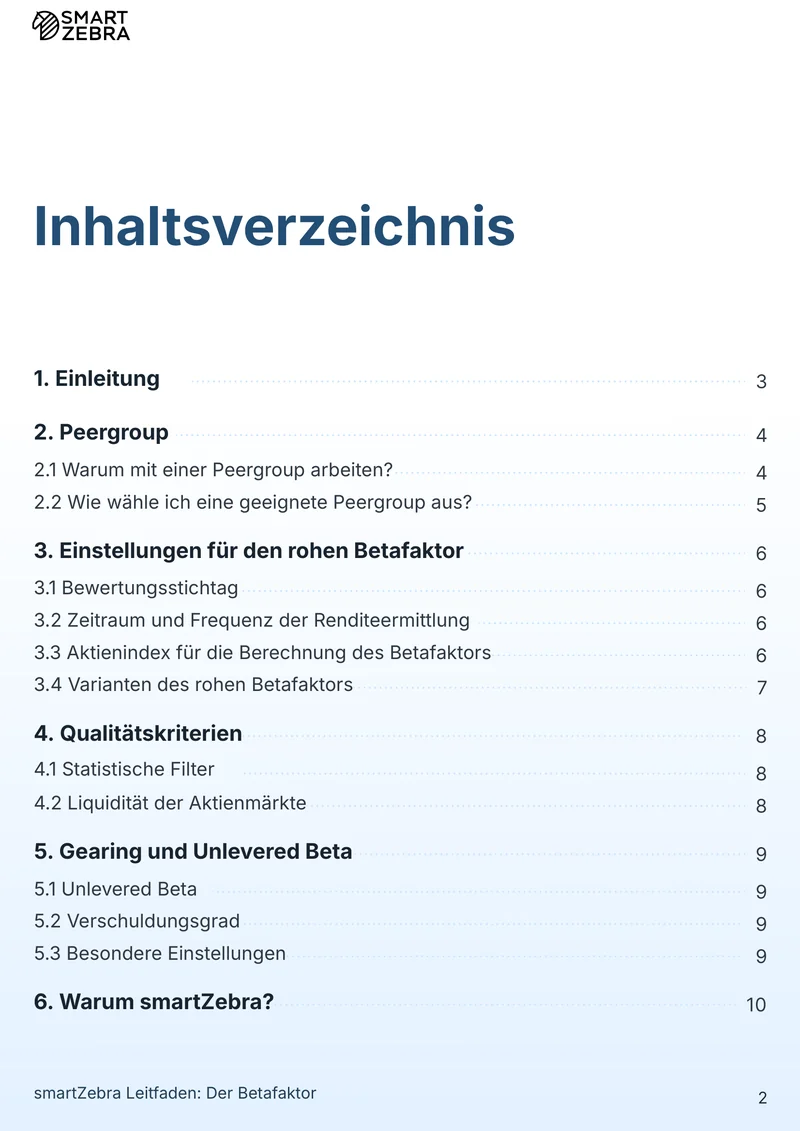
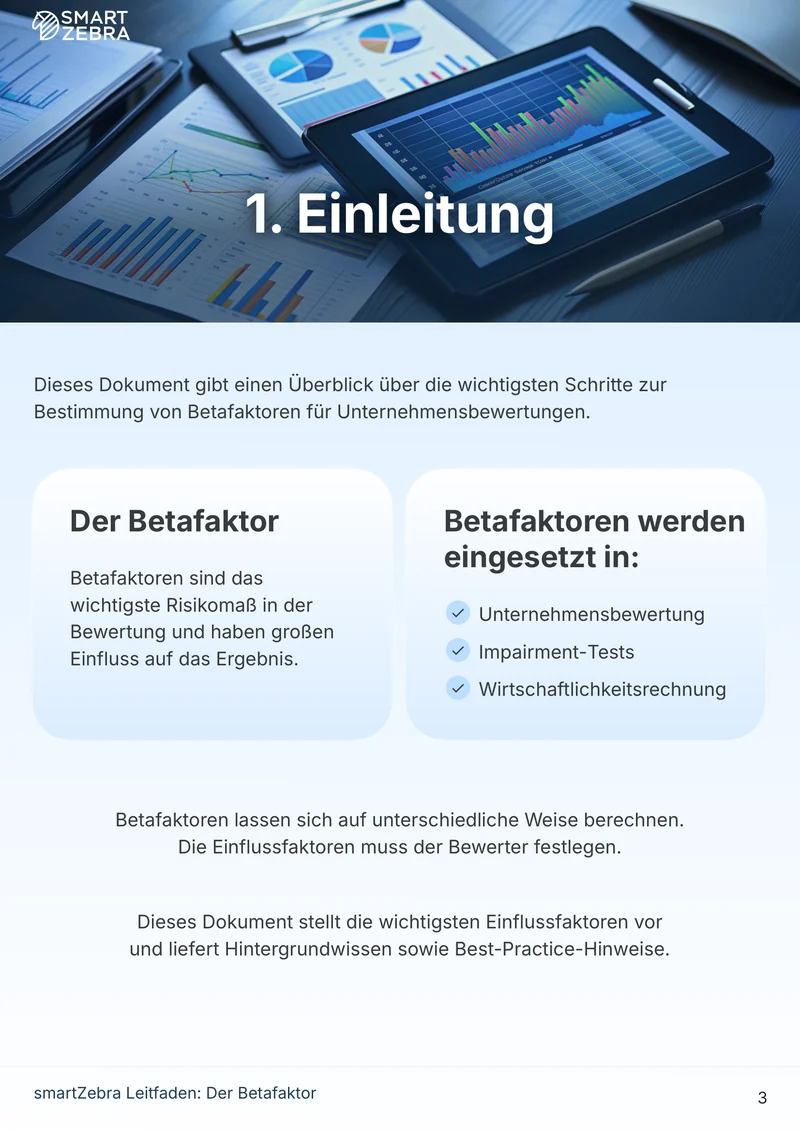
Page preview: table of contentsPage preview: introduction

In short

A beta factor measures how strongly a company's equity returns move with the market. In a business valuation under IDW S 1, or an impairment test under IAS 36, the beta feeds the cost of equity, so small setting choices change the result. The smartZebra guide covers the five decisions behind a defensible beta.

‍

What you'll learn

01 · Why a peer group beats industry betas

Industry betas give rough data. IDW S 1 and IAS 36 point to a peer group tailored to the valuation object.

02 · How to choose comparable companies

Horizontal, vertical and cross-industry search, checked against sales growth, EBITDA margin and return on assets.

03 · Raw-beta settings that move the number

Valuation date, return period and frequency, and the choice of stock index.

04 · Total beta and adjusted beta

What each variant adds, when it is used, and why experts treat total beta with caution.

05 · Is this beta reliable?

Coefficient of determination (R²), t-test, bid-ask spread, trading volume and trading days.

06 · Gearing and unlevered beta

Consistent debt ratios including leases and pensions, the tax shield and debt beta.

‍

Used by valuation professionals

“We have already used smartZebra several times to determine beta factors. This allows us to work much more efficiently than before.” — Andrew Grums, Partner & Auditor/Tax Advisor, DELFS
“The selection of the peer group, which is usually time-consuming, works very quickly and reliably.” — Achim Dörner, Managing Partner, DWT.

Audit-proof beta in 5 steps

The checklist valuation pros keep open.

Instant PDF download

Questions & Answers

What is a beta factor?

A beta factor measures how strongly a company's share returns move with a market index. In valuation, it sets the risk premium in the cost of equity.

Why use a peer group instead of an industry beta?

A peer group matches the risk structure of the valuation object. Industry betas only give a rough average, and standards such as IDW S 1 and IAS 36 point to a specific peer group.

What is the difference between raw, adjusted and unlevered beta?

Raw beta comes straight from the return regression. Adjusted beta corrects it for expected future risk. Unlevered beta removes the financing risk of each peer, so peers with different debt levels become comparable.

How do I know if a beta is statistically reliable?

Check the coefficient of determination (R²) and the t-test of the regression, and check the share's liquidity (bid-ask spread, trading volume, trading days).

Is the guide free?

Yes. The smartZebra beta-factor guide is a free PDF with practical checklists and settings; we only ask for your business e-mail so we can send it.

Which standards does the guide cover?

The guide follows IDW S 1 for business valuations and IAS 36 for impairment tests. It covers the beta decisions both standards call for: peer group, raw-beta settings, quality checks, gearing and unlevering.

Try the Full Platform
Free for 5 Days.

Valuation Pro, Benchmarking Pro and Credit Spreads Pro: betas and WACC inputs, arm’s-length comparables and credit spreads, every figure with its source.

Full platform access
No hidden fees
No credit card required